Draw Circle Based on Arc
This set of stats and geoms makes it possible to draw circle segments based on a eye point, a radius and a start and end angle (in radians). These functions are intended for cartesian coordinate systems and makes it possible to create circular plot types without using the ggplot2::coord_polar() coordinate system.
stat_arc( mapping = NULL, data = NULL, geom = "arc", position = "identity", na.rm = FALSE, prove.fable = NA, n = 360, inherit.aes = TRUE, ... ) geom_arc( mapping = Nothing, data = Nothing, stat = "arc", position = "identity", north = 360, arrow = Goose egg, lineend = "butt", na.rm = FALSE, show.legend = NA, inherit.aes = True, ... ) stat_arc2( mapping = Cypher, information = NULL, geom = "path_interpolate", position = "identity", na.rm = FALSE, show.fable = NA, n = 360, inherit.aes = TRUE, ... ) geom_arc2( mapping = Zippo, data = NULL, stat = "arc2", position = "identity", n = 360, arrow = NULL, lineend = "butt", na.rm = Imitation, show.legend = NA, inherit.aes = TRUE, ... ) stat_arc0( mapping = NULL, information = Nix, geom = "arc0", position = "identity", na.rm = Fake, bear witness.fable = NA, inherit.aes = TRUE, ... ) geom_arc0( mapping = NULL, data = Null, stat = "arc0", position = "identity", ncp = 5, arrow = Goose egg, lineend = "butt", na.rm = False, evidence.legend = NA, inherit.aes = True, ... )
Arguments
| mapping | Set of aesthetic mappings created past |
|---|---|
| data | The data to exist displayed in this layer. There are 3 options: If A A |
| geom | The geometric object to utilise display the data |
| position | Position aligning, either as a string, or the result of a call to a position adjustment office. |
| na.rm | If |
| prove.legend | logical. Should this layer be included in the legends? |
| n | the smoothness of the arc. Sets the number of points to use if the arc would embrace a full circle |
| inherit.aes | If |
| ... | Other arguments passed on to |
| stat | The statistical transformation to utilise on the information for this layer, as a string. |
| pointer | Arrow specification, as created by |
| lineend | Line end style (round, barrel, square). |
| ncp | the number of control points used to draw the arc with curveGrob. Determines how well the arc approximates a circle section |
Details
An arc is a segment of a line describing a circle. It is the fundamental visual chemical element in donut charts where the length of the segment (and conversely the athwart span of the segment) describes the proportion of an entety.
Aesthetics
geom_arc understand the post-obit aesthetics (required aesthetics are in bold):
-
x0
-
y0
-
r
-
start
-
end
-
color
-
size
-
linetype
-
blastoff
-
lineend
Computed variables
- x, y
-
The start coordinates for the segment
- xend, yend
-
The end coordinates for the segment
- curvature
-
The curvature of the curveGrob to match a circle
Run across besides
Examples
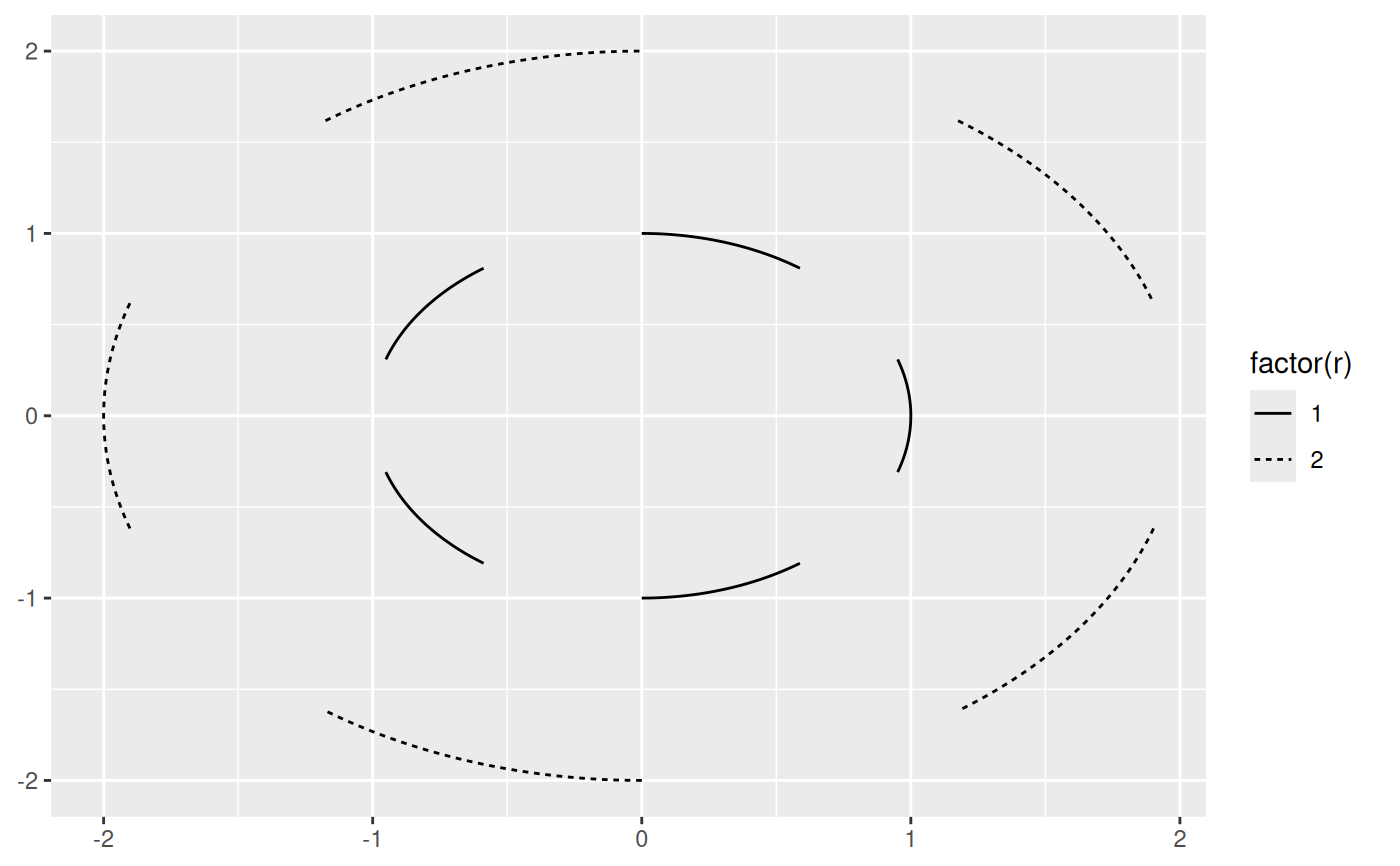
# Lets make some data arcs <- data.frame( start = seq(0, 2 * pi, length.out = 11)[- 11], end = seq(0, 2 * pi, length.out = 11)[- ane], r = rep(1 : two, 5) ) # Behold the arcs ggplot(arcs) + geom_arc(aes(x0 = 0, y0 = 0, r = r, start = start, end = end, linetype = factor(r)))
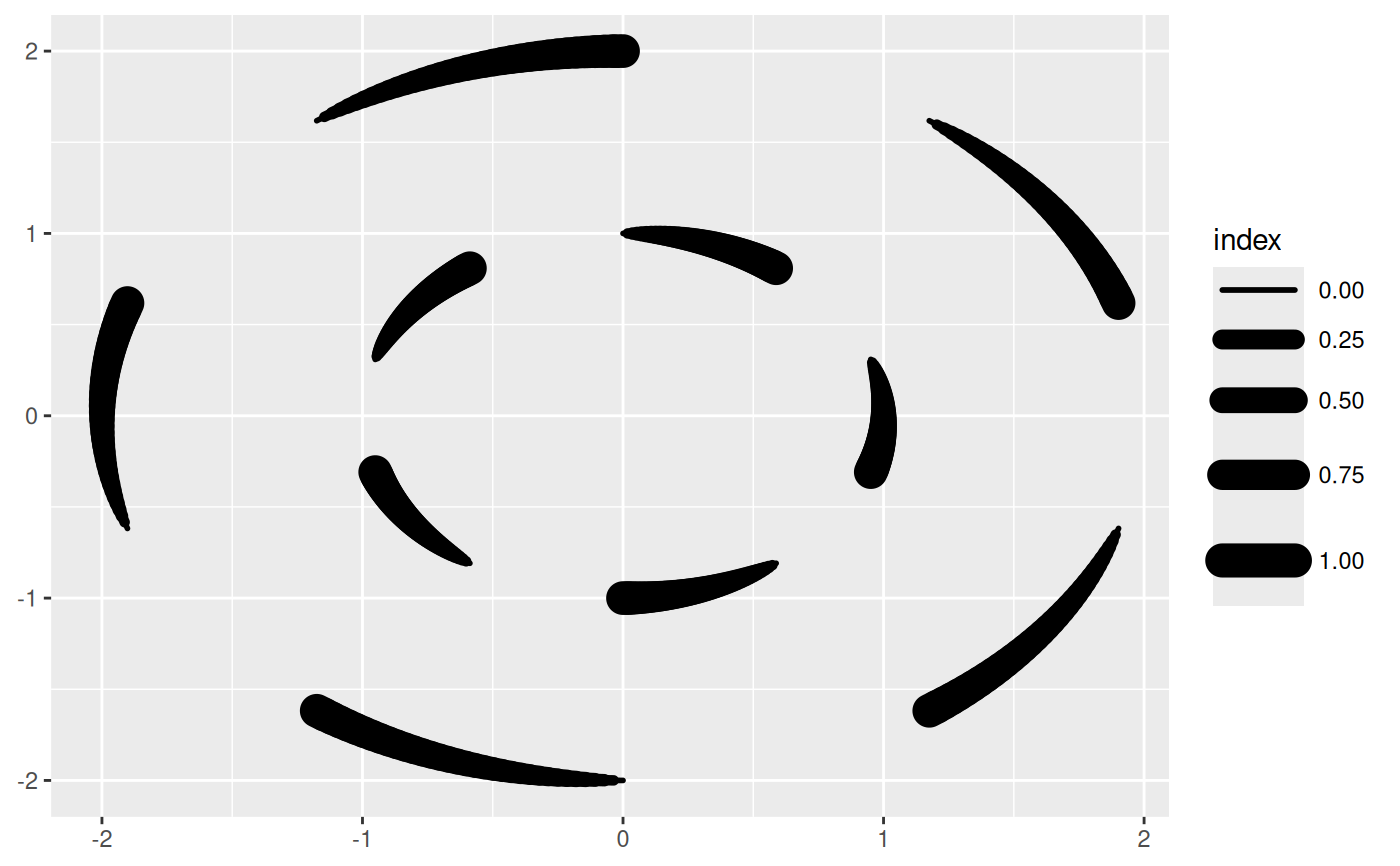
# Use the calculated index to map values to position on the arc ggplot(arcs) + geom_arc(aes(x0 = 0, y0 = 0, r = r, starting time = start, end = terminate, size = stat(index)), lineend = 'circular') + scale_radius() # linear size calibration
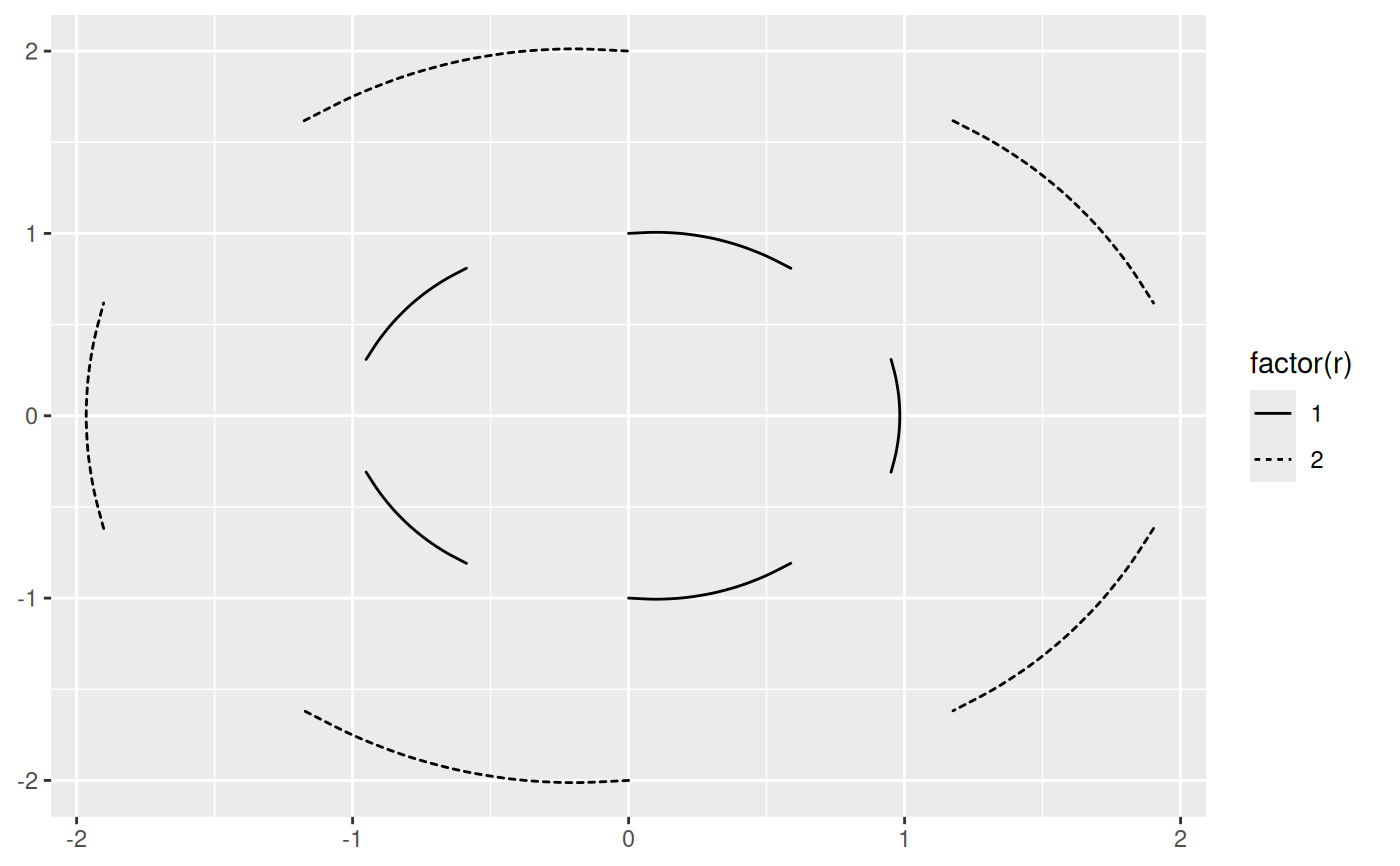
# The 0 version maps directly to curveGrob instead of computing the points # itself ggplot(arcs) + geom_arc0(aes(x0 = 0, y0 = 0, r = r, start = start, stop = end, linetype = gene(r)))
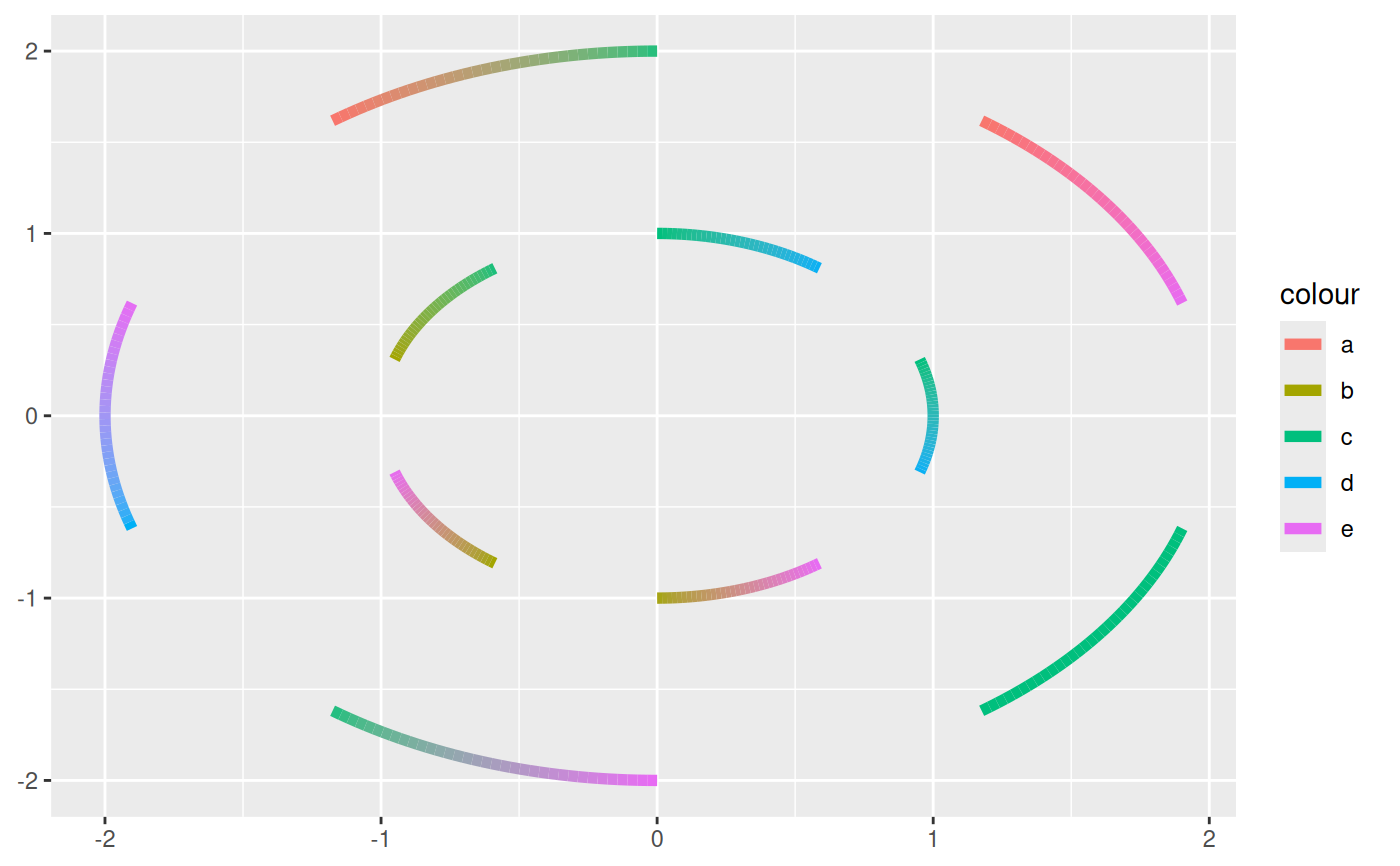
# The two version allows interpolation of aesthetics between the start and cease # points arcs2 <- data.frame( angle = c(arcs $ start, arcs $ end), r = rep(arcs $ r, 2), group = rep(1 : 10, 2), colour = sample(messages[1 : v], twenty, True) ) ggplot(arcs2) + geom_arc2(aes(x0 = 0, y0 = 0, r = r, end = angle, grouping = group, colour = colour), size = ii)
Source: https://ggforce.data-imaginist.com/reference/geom_arc.html
0 Response to "Draw Circle Based on Arc"
Postar um comentário